

The headlines have already buried SEO. AI is eating the search results, the clicks have dried up, time to pack it in. They’re reading the data correctly and drawing exactly the wrong conclusion. AI isn’t making SEO irrelevant; SEO is quietly becoming the brain that powers AI’s decision-making.
01 · THE PANIC
The 68% that’s making marketers panic
In the first four months of 2026, 68.01% of US Google searches ended without a click. That’s the number lighting up everyone’s group chat. On the top line it looks like organic search, and even PPC, is being quietly killed off by the smarter, shinier thing everyone’s talking about.
It’s true, clicks to the open web are on a slow decline. But in the same window, Google’s ad revenue hit $77.25 billion last quarter, up 15.5% year over year, with search revenue up 19% and queries at an all-time high.
Wait — how can both of those things be true at the same time? Because Google holds structural advantages no other company on Earth can match, and not even the AI firms everyone’s betting on come close.
02 · THE REASON
Google holds the master record
Consider Google’s reach. It captures behavioral signals from each of the more than 400 billion searches it logs every month — what you skip, what you hover over, how long you linger, how far you scroll, whether you bounce straight back, and a great deal more. YouTube Shorts alone logs over six trillion views a month, each one tracking its own metrics: watch time, rewatches, scrolls, clicks, likes, shares, comments. Add the entire Android ecosystem, Chrome, Maps, the analytics tags running on tens of millions of websites Google doesn’t even own, and the roughly 3.6 trillion messages flowing through Gmail every month, and you’re looking at a knowledge base of unparalleled size and scope.
To be fair, Google doesn’t publish a master tally of what it captures, and we’re not aware of any explicit data-sharing deal between Google and the LLM platforms. But Gemini already grounds its answers on Google’s index, and AI answers broadly lean on whatever ranks highly in Google — which means SEO work product is now central to how they operate. This is the data LLMs are hungry for, and one way or another, Google holds the master record of how humans have used the internet for the last several decades.
03 · THE PROOF
And the engines read straight through it
It’s not only what Google knows. It’s what the AI engines physically read, and most of what they read, Google mapped first.
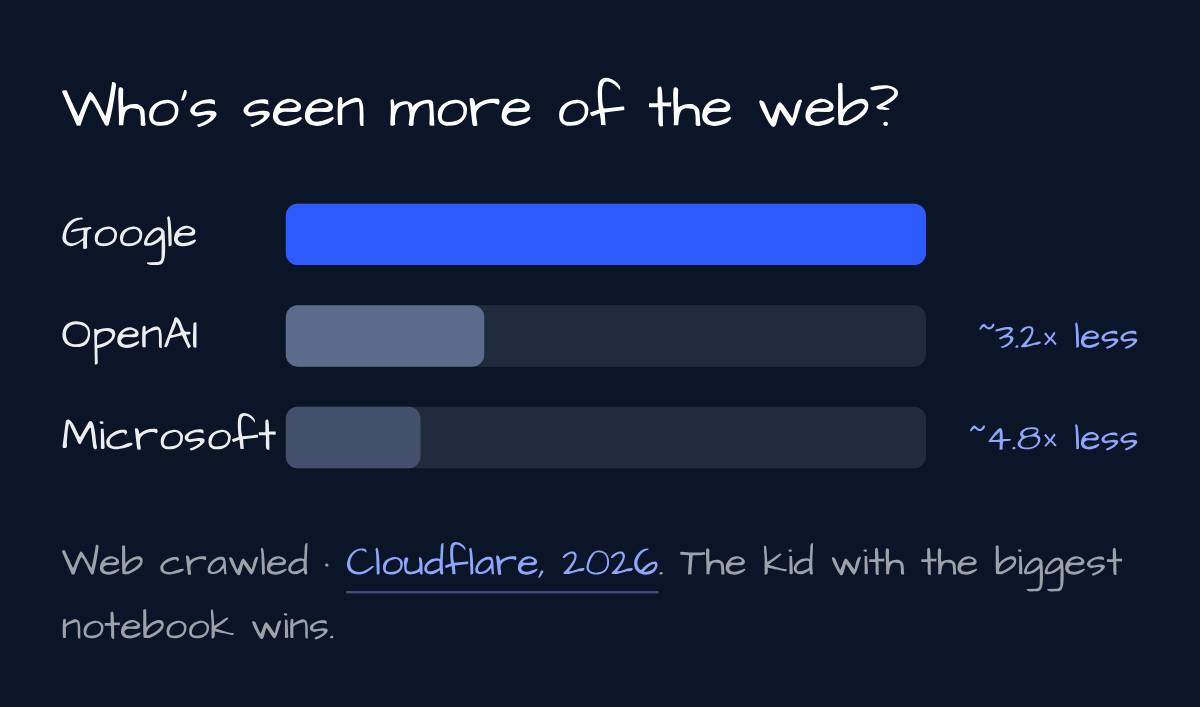
The crawl gap is enormous. Cloudflare’s CEO puts Googlebot at about 3.2x more of the web than OpenAI and 4.8x more than Microsoft. Measured a different way, the chasm is even starker: in Botify’s analysis of enterprise server logs, Google’s crawlers logged 18.2 billion events in a single month against OpenAI’s 887 million — ChatGPT is roughly 4% of Google’s crawl. The gap is closing, but it’s still a canyon.
Ranking used to win you a click. Now it wins you something much better: not a giant page of links to click through, but the recommendation of AI systems consumers are growing to trust.
04 · THE MOVE
Change the scorecard, not the strategy
Being found used to mean a blue link and a click. Now it means being the source the machine repeats when a qualified buyer asks it who to trust.
The work that earns organic search rankings is the work that earns AI citations. SEO is AEO. So don’t cut your content. Stop grading it by traffic alone and start grading it by influence. When your buyer asks an AI who to trust in your category, are you the answer?
05 · DO THIS
Your next moves
If you take one thing from this, it’s that the panic is backwards. Here’s where to point your energy instead, starting this week.
- Ask the machines what they say about you. Open ChatGPT, Gemini, and Perplexity and ask each one who the best providers in your category are. Write down whether you show up, and what they say. That’s your new baseline, and most of your competitors have never checked theirs.
- Don’t defund the thing AI feeds on. Cutting content and SEO because “clicks are down” is like ripping out the roots because the plant needs water. The pages that rank are the pages the models read and repeat.
- Change what you measure. Rankings and traffic still matter, but add one question to the scorecard: when a qualified buyer asks an AI who to trust, are you in the answer? Influence is the metric now, not just clicks.
- Earn the rankings that do double duty. Being genuinely the best, most trustworthy answer to your buyers’ real questions now wins you a click and a citation. Write for the human; the machine is reading over their shoulder.
- Build the trust the models reward. AI recommends on trust and context-fit, not keyword tricks. That’s Trust Architecture: the work of being found and being chosen, designed on purpose instead of left to chance.
SOURCES
- SparkToro / Similarweb — zero-click search data; AI answers draw from what ranks in Google (Rand Fishkin, June 2026). link
- Alphabet Q1 2026 earnings — advertising and search revenue (reported April 29, 2026). link
- Search Engine Land — Google’s 5 trillion searches a year (~417 billion/month). link
- YouTube — Shorts averaging 200 billion daily views (~6 trillion/month). link
- Gmail usage data — roughly 121 billion messages handled daily (~3.6 trillion/month). link
- Cloudflare — Googlebot crawl coverage vs. OpenAI and Microsoft (CEO Matthew Prince, 2026). link
- Botify — enterprise log-file analysis of Google vs. OpenAI crawl events; Gemini grounding on Google’s index (2026). link